

Sixty-four days. That’s the median time a listing sat before going off market across the Dallas-Fort Worth metro in October 2026, according to Realtor.com data tracked by the St. Louis Fed. Two months of showings, two months of keeping a house spotless, two months of coordinating with someone you’re in the middle of untangling your life from. That arithmetic is why selling a house during a divorce in Texas feels so different from any other sale you’ll ever make. The house isn’t just a house anymore, it’s the biggest number on a spreadsheet two lawyers are arguing over, and every week it sits unsold, the pressure builds for everybody involved.
Why Does Divorce Make Selling a Home So Complicated?
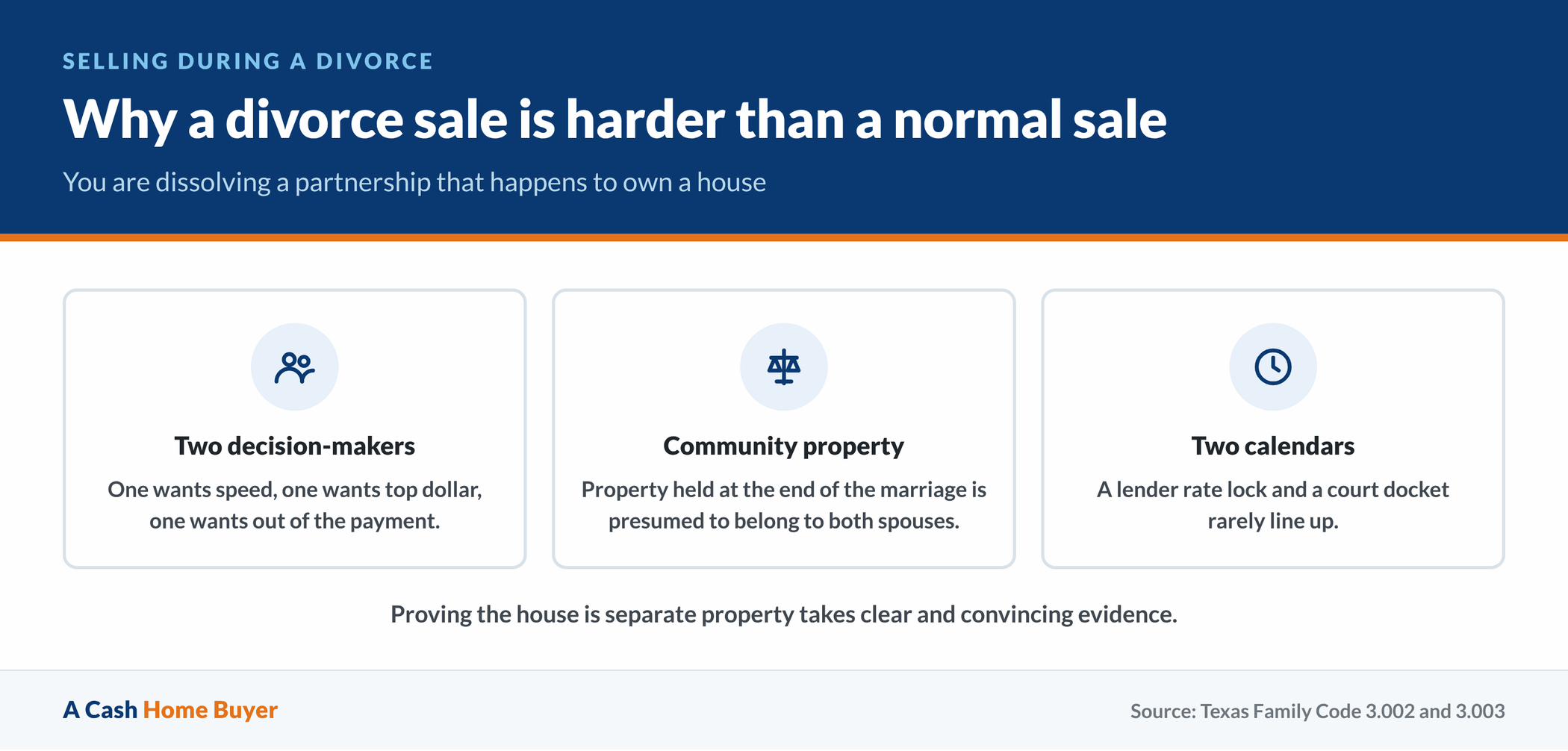
You’re not selling a house. You’re dissolving a partnership that happens to own one, and those are two completely different projects.
Most home sales have one decision-maker, or two people who agree. A sale during a divorce has two people whose incentives just split apart. One wants speed. One wants top dollar. One wants to stop paying for a house they moved out of in March. Those aren’t character flaws; they’re just different positions on the same asset.
Texas has its own layer on top of that. Under Texas Family Code Section 3.003, property either spouse holds at the end of the marriage is presumed to belong to both of them, no matter which name sits on the deed. Section 3.002 defines community property as whatever either spouse picked up during the marriage that isn’t separate property. A spouse who wants to prove the house is separate carries the burden, and the standard is clear and convincing evidence.
Then there’s the court calendar, which answers to nobody. A buyer’s lender has a lock expiration. A judge has a docket. Those two schedules collide more often than people expect going in, and the sale is usually what gives.
Last year a couple in Rowlett called me about a rent house they’d bought as a retirement plan. Neither one wanted to keep managing it through a divorce, and the tenant had stopped paying in the spring. They were done chasing rent checks from two different addresses, which is actually the first thing they told me on the phone.
You let emotion complicate the money too. A kitchen one spouse remodeled by hand carries a price in their head that no appraiser will ever confirm. We see this constantly in houses we’ve looked at buying. The house gets listed high because nobody wants to be the one who said yes to less.
What Should Texas Homeowners Know About Selling During a Divorce?
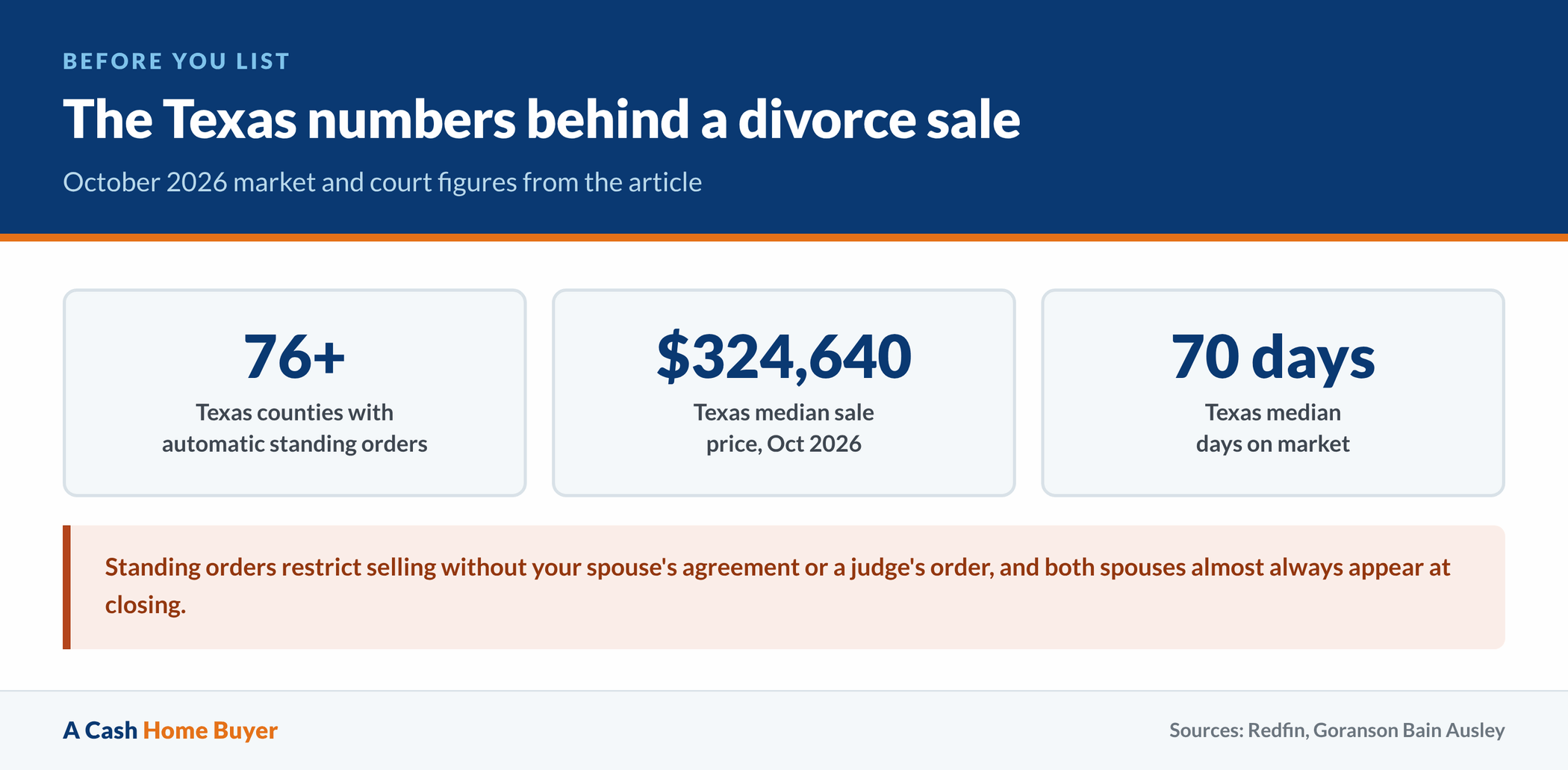
Plenty of people file for divorce in Texas on a Tuesday and call a listing agent on Wednesday. In Dallas, Collin, Denton, Rockwall, and Kaufman counties, that call is already governed by a court order nobody handed them. Standing orders attach automatically the moment the petition hits the clerk, and they restrict selling or transferring property without the other spouse’s agreement or a judge’s signature. Goranson Bain Ausley notes that more than 76 Texas counties work this way, including Travis and Bexar. Harris and Tarrant don’t, so a spouse there has to actually request a temporary restraining order.
Does that mean you can’t sell? No. It means the sale needs both signatures or an order, which is a procedural step, not a wall.
Texas market conditions matter here as much as Texas law does. Statewide, the median sale price landed at $324,640 in October 2026, down 3.1 percent year over year, per Redfin’s Texas tracking. Median days on market across Texas hit 70 that same month. A softening market changes the calculus on waiting: holding out for last year’s price while paying this year’s carrying costs is a losing trade in most Texas zip codes right now.
Carrying costs don’t pause for a divorce case. Mortgage, insurance, property taxes, lawn service, the electric bill on an empty house in August. Who pays while the case is pending? Settle that before you list, in writing, or you’ll be arguing about it in month four.
One more thing worth understanding before you sign anything: both spouses almost always have to appear at closing, even if only one name is on the loan. Texas title companies are careful about marital status. They’ll ask.
How Do You Protect Marital Assets During a Texas Divorce?
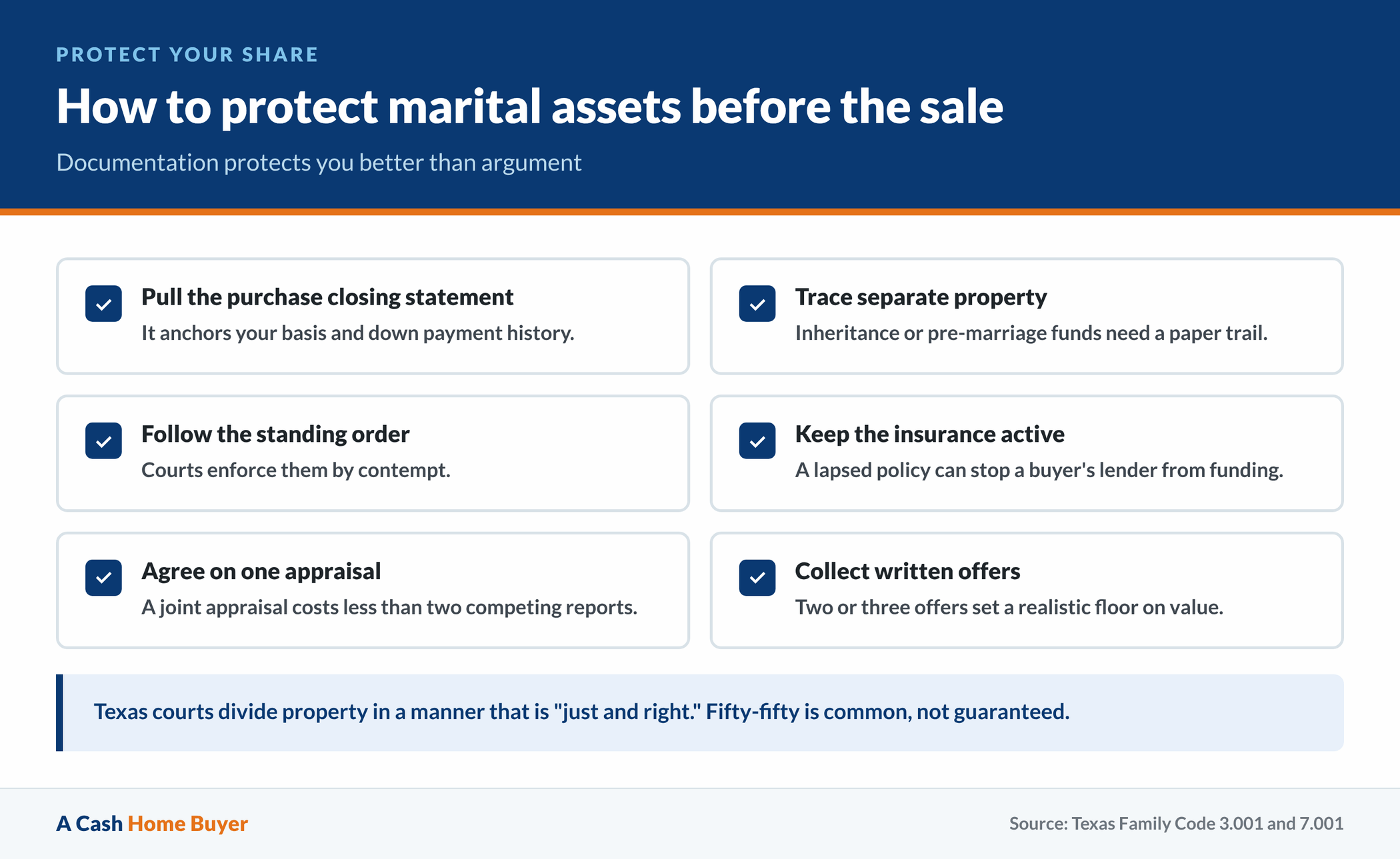
A Texas judge isn’t required to split your community estate down the middle. Family Code Section 7.001 directs courts to divide property in a manner that’s “just and right,” and family law practitioners consistently point out that judges weigh things like each spouse’s earning capacity and the needs of the children. Fifty-fifty is a common outcome, not a guaranteed one. Couples who plan around an automatic even split sometimes get a surprise.
Documentation protects you better than argument does. Pull the closing statement from when you bought the house. Find the records of any down payment that came from an inheritance or a pre-marriage account. Separate property under Section 3.001 includes what you owned before the wedding and what came to you by gift or inheritance, but tracing it requires paper.
The judge enforces a standing order with real teeth. Courts can enforce them by contempt, which can mean fines, attorney’s fees for the other side, and in some cases jail time.
Keep the insurance active. I’ve watched a deal die because a spouse who moved out stopped paying the homeowner’s policy, nobody noticed for two months, and the buyer’s lender refused to fund. An empty house with lapsed coverage is also a gift to vandals and burst pipes during a January freeze in the Panhandle.
Appraisals can get contentious in a divorce. One spouse orders a low one; the other orders a high one. A joint appraisal both parties agree to in advance costs less than two competing reports plus the fight over which is right. Some couples instead get written offers from two or three buyers, including a cash buyer, to establish a realistic floor on the Texas property’s value. This approach gives both lawyers a number they can work with instead of a theory.
What Does Selling Your Home for Cash During a Divorce Mean?

A cash sale is a liquidity decision, not a desperation move, and treating those as the same thing costs Texas couples real money every year.
Mechanically, it works like this. A cash buyer purchases the property with their own funds, so there’s no mortgage application, no underwriter, no appraisal contingency that can blow up in week five. The offer is typically below full retail because the buyer absorbs repairs, carrying costs, and resale risk. In exchange, you get a closing date you can put on a calendar and hand to your attorney with confidence.
During a divorce, certainty has a dollar value most people don’t price correctly. Every extra month of a Texas mortgage, insurance premium, and tax escrow comes straight out of whatever both spouses eventually split, which means the clock itself is costing them. Two months of carrying a $2,400 monthly payment is $4,800 nobody gets to divide.
Buyers like A Cash Home Buyer work in this lane across the DFW area and other Texas markets, purchasing as-is and closing on the seller’s timeline rather than a lender’s. For a couple who needs one clean number to divide, that structure removes a lot of moving parts.
Should everybody sell for cash during a divorce? Absolutely not. If your home is in good shape, in a neighborhood where buyers still compete, and both spouses can cooperate for a couple of months, list it. You’ll likely net more.
The honest version: a cash sale trades some of the top-end price for speed, certainty, and the elimination of repair negotiations. Whether that trade makes sense depends on how much the delay is costing you and how functional your communication is right now.
Cash Sale or Traditional Sale: Which Is Better During a Divorce?
A couple in Plano listed at $415,000 in June, dropped to $389,000 in August, and went under contract in October with a buyer who asked for $9,000 in repairs. Their net after five months of payments, two price cuts, and commissions landed close to the cash offer they’d turned down in the spring.
That’s not an argument against listing. It’s an argument for doing the math with real Texas numbers instead of hope.
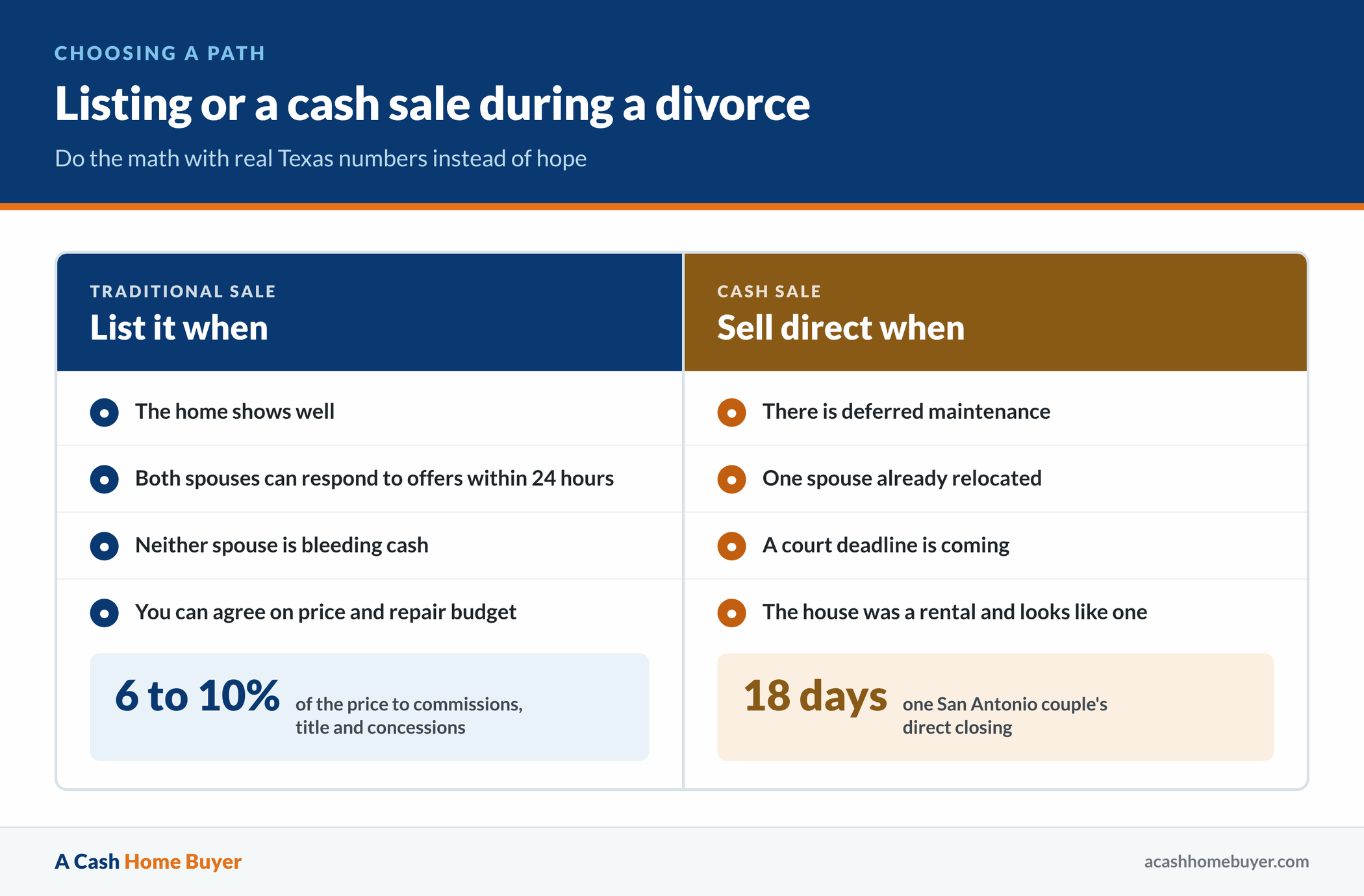
A traditional sale makes sense when the Texas home shows well, when both spouses can agree on price and respond to offers within 24 hours, and when neither party is bleeding cash. Higher gross price, more net in most cases. The tradeoff is time and cooperation, and divorce is short on both.
Selling a house during a divorce through a cash buyer makes sense under different conditions. Deferred maintenance you don’t want to fund jointly. A spouse who’s already relocated for work. A court-ordered deadline. A property that was a rental and looks like one.
Ask yourself this plainly: can you and your spouse agree, this week, on a list price and a repair budget? If the answer involves a pause, listing may cost more than it earns.
Commissions belong in the comparison too. Expect to give up roughly 6 to 10 percent of your sale price in a traditional Texas transaction. This happens once you add agent commissions, title charges, and whatever concessions a buyer negotiates. This occurs in a market where sellers are already cutting. Statewide sale-to-list ratios have been sitting under 98 percent through 2026, so the list price isn’t the price.
Repairs are the other variable. Foundation work in North Texas clay soil runs into five figures fast, and a buyer’s inspector will find it. Cash buyers price that in and move on. Retail buyers renegotiate, or walk, and in a divorce a walked deal restarts a clock you can’t afford.
What Are the Benefits of a Cash Sale During a Divorce?

And the biggest one isn’t the money at all. It’s that the transaction stops being a thing you have to coordinate with your soon-to-be ex every single week.
You must keep the house clean and vacate on short notice for showings. When one spouse still lives there and the other is paying half the mortgage, every showing turns into a negotiation. Remove showings and you remove a recurring argument.
Closing speed is the obvious benefit. A Texas cash transaction can close in a couple of weeks once title clears, compared to a financed deal where the lender alone takes 30 to 45 days after the contract.
As-is sales eliminate the repair fight entirely. Nobody has to decide who pays for the water heater or whether the roof claim was community expense. One price, one closing, one number to divide.
Financing fallout disappears too. Roughly one in twenty contracts nationally collapses because the buyer’s loan fails, and that failure lands hardest on sellers with a court date approaching.
Texas sellers consistently underestimate how much privacy counts. No sign in the yard in a neighborhood where your kids’ friends live, no open house where the neighbors walk through, no listing photos circulating online. A quiet sale during a divorce spares children in schools from Southlake to Alamo Heights a lot of questions they shouldn’t have to answer.
One pattern I keep seeing: the spouse who wants to keep the house often can’t qualify alone. They find out after four months of trying to refinance, and by then the market shifted under them. I’ve watched this exact scenario stall more than one deal, so running the refinance numbers with a lender before anyone commits to a plan saves everybody that detour.
How to Sell a House During a Divorce in Texas
“Do we need the judge’s permission first?”
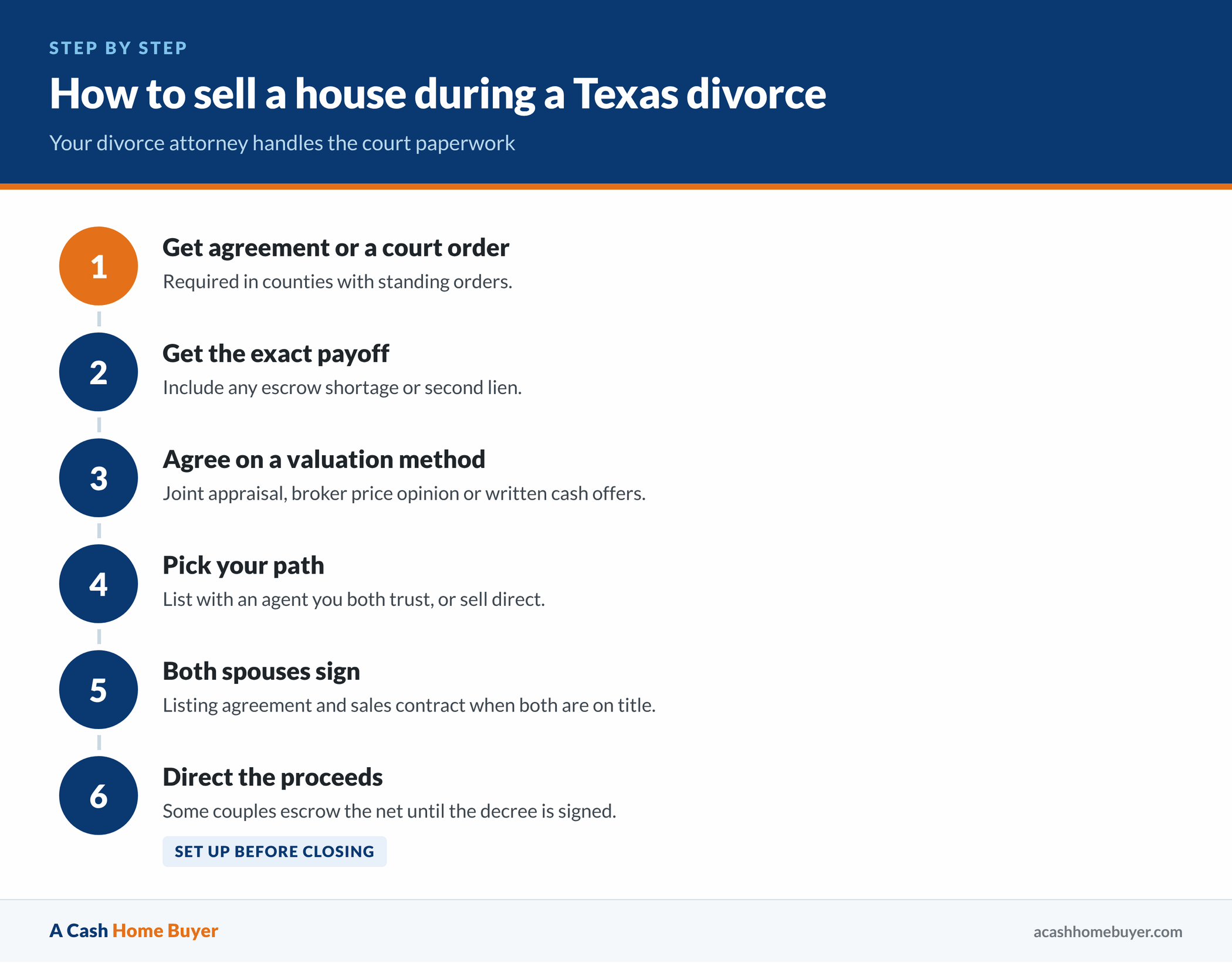
That’s usually the first real question. In the Texas counties with standing orders, you need either your spouse’s written agreement or a court order before you can transfer the property. Your divorce attorney handles that paperwork; it’s routine.
Start with an honest payoff figure. Call your servicer and get the exact number, including any escrow shortage or second lien. Home equity in Texas is what’s left after that, minus selling costs, and that remainder is what gets divided.
First, you’ll want to agree on a valuation method and put it in the settlement discussions. A single joint appraisal, a broker price opinion, or written cash offers all work. What doesn’t work is two spouses arguing from two different Zillow estimates.
Then pick your path. Listing requires choosing an agent both parties trust, which is harder than it sounds, plus agreement on price, timeline, and how offers get accepted. A direct sale requires agreement on one offer. Fewer decision points, fewer stalemates.
Both spouses sign the listing agreement and the sales contract when both are on title. Texas title companies will also want to see the divorce decree if it’s final, or confirmation that the sale is authorized if it isn’t.
Proceeds typically go to the title company and then follow whatever the parties or the court directed. Some couples escrow the net proceeds until the decree is signed, so your attorney should set that up before closing, not during.
Taxes deserve a conversation with your CPA. Married couples filing jointly can exclude up to $500,000 of gain on a main home, and single filers up to $250,000, provided the ownership and use tests in IRS Publication 523 are satisfied. Timing your Texas sale relative to your filing status can change the bill.
How Do You Keep a Home Sale Smooth During a Divorce?

A seller in Katy told me she and her husband had stopped speaking altogether, but they both answered emails from the title company within an hour. That sale closed on time because they routed everything through a neutral third party instead of each other.
Copy that. Designate one point of contact, usually the title company or one attorney’s paralegal, and let all sale communication flow through them. No texting about earnest money at 11 p.m.
Decide in advance who signs what and when. If one spouse has moved to Austin and the other is in Lubbock, remote notarization and mail-away closings are standard in Texas. Your title company can arrange both.
Put the small decisions in writing before they come up. Who handles the lawn. Who meets the inspector. Who pays the utility bill during the escrow period. These sound trivial until the grass is a foot high during a showing in a Texas July.
Keep the children out of the logistics completely. Moving twice is hard enough on kids without them fielding questions from buyers’ agents.
Realistic pricing prevents most stalemates. With Houston-area single-family homes averaging 59 days on the market in October 2026 according to the Houston Association of Realtors, an aggressive list price in any major Texas metro means months of carrying costs before the inevitable reduction.
One thing I’d push back on: the common advice to “just let the house sit until the divorce is final” is usually bad counsel. This is true in a Texas market where inventory is climbing and prices are flat to down. Waiting costs you payments and exposes both spouses to further softening.
Warranty Deed Versus Deed of Trust: What Matters During a Divorce?
Does it matter which one is on your house? For years I’d hear sellers use those two terms interchangeably, and I didn’t correct it often enough, because the difference decides who’s still on the hook after the Texas divorce is over.
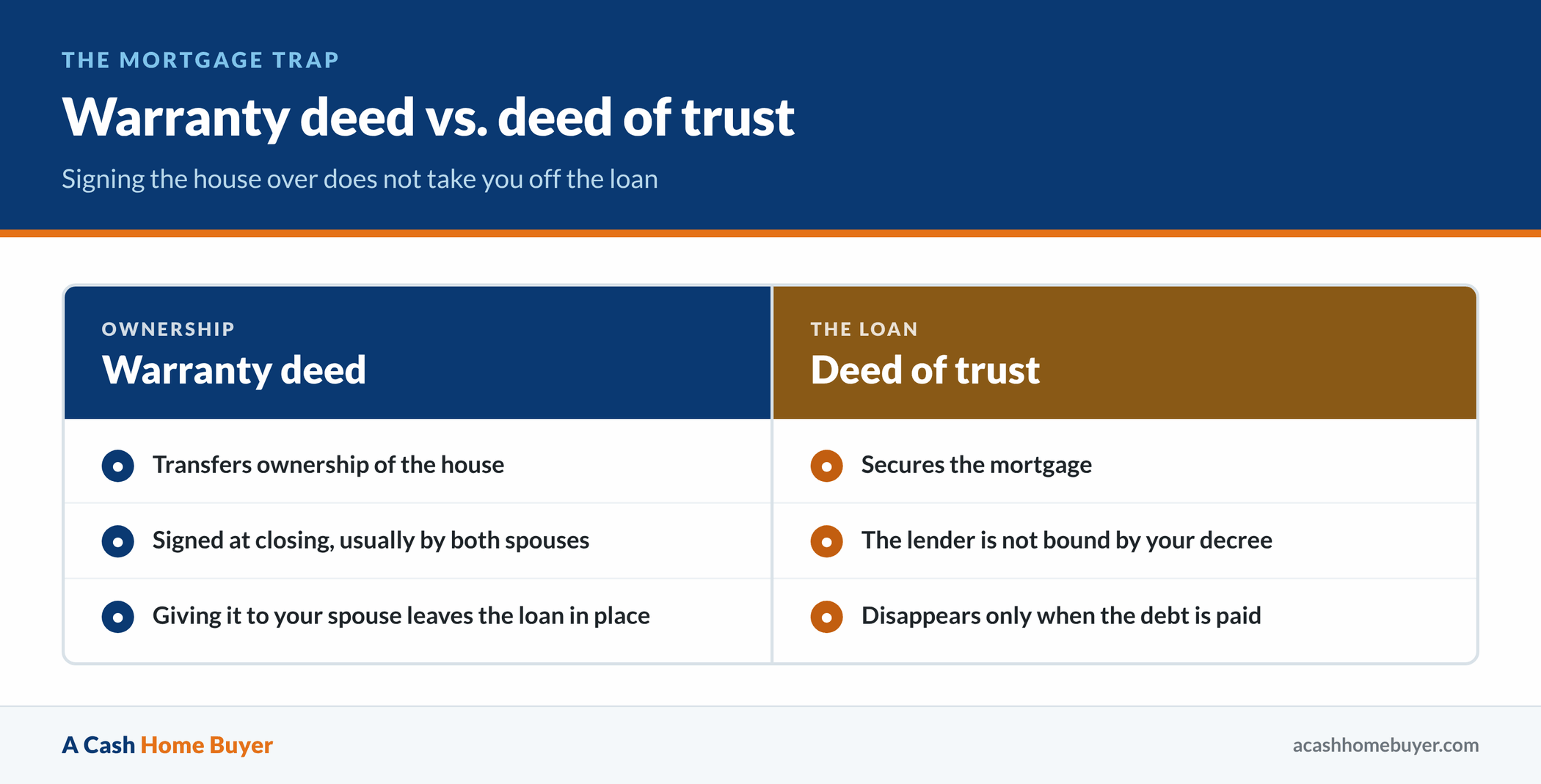
A warranty deed transfers ownership. A deed of trust secures the loan. Signing a deed that gives your spouse the house does not remove you from the mortgage note, and the lender has no obligation to care about your decree.
That’s the trap. A spouse signs a special warranty deed in the divorce, walks away believing they’re clear, and the loan still reports on their credit for years. A late payment by the ex damages the credit of a person who hasn’t lived there since the decree.
Two real fixes exist. The keeping spouse refinances into their own name, or the house sells and the loan gets paid off at closing. Everything else is a workaround with exposure attached.
Refinancing in late 2026 is a different conversation than it was five years ago. Freddie Mac’s 30-year average reached 7.40 percent on October 8, 2026. A spouse sitting on a 3 percent loan from 2021 who refinances to keep the Texas house is more than doubling the interest rate on whatever balance remains. It’s worth running the new payment before signing anything.
A Texas owelty lien is the tool attorneys use when one spouse buys out the other’s equity through a refinance. It lets the refinancing spouse borrow against the full value rather than just their half interest. Ask your lender and your lawyer about it specifically; not every loan officer handles them regularly.
Which document conveys your Texas property to a buyer? The warranty deed, signed at closing, usually by both spouses. The deed of trust only disappears when the underlying debt is paid.
How One Texas Couple Sold Their House During a Divorce
“A cash buyer is just going to lowball me and I’ll regret it.” Fair concern, and sometimes true. The defense is simple: get more than one offer, and compare each against your actual net after commissions, repairs, and three more months of payments.
Near San Antonio, a couple did exactly that. Their 1990s home needed a roof and had original HVAC. Their agent’s comparative market analysis assumed both repairs were done.
They collected two cash offers and one listing proposal, ran the numbers side by side, and found the gap was about $14,000 before repairs. After the roof bid came in, the gap closed to under $5,000. They sold directly and closed in 18 days, which let the decree get signed that same month.
Would they have netted more by listing? Possibly, by a small margin, if nothing went wrong across 70-plus days on market. The San Antonio Board of REALTORS reported inventory at 5.96 months in October 2026, with a median sale price of $299,370 flat year over year. Nothing about that data promises a quick, clean retail sale.
A man called me on a Wednesday afternoon from Pearland, splitting assets in a divorce, and the only thing he wanted was for somebody else to handle it. His garage still had his ex-wife’s exercise equipment and about forty boxes neither of them had opened since the move, so we bought it with everything in it. He told me the relief of not sorting through those boxes was worth more to him than the difference in price.
Frequently Asked Questions
Who Typically Ends Up with the House in a Texas Divorce?
Either spouse can, or neither. Texas courts follow the just-and-right standard described earlier, weighing factors like which parent has primary custody, each spouse’s ability to carry the payment alone, and whether either can prove a separate-property interest. Plenty of Texas couples skip the fight entirely and sell during a divorce so both walk away with cash instead of one carrying a mortgage they can’t afford.
How Can I Afford to Live After a Texas Divorce?
Start by building a budget around one income before the decree is final, not after. Your share of the home equity is usually the largest liquid asset available, which is why how and when you sell during a divorce matters so much to what comes next. Talk to a lender early about what you can qualify for on your own, because a pre-approval amount often looks different than people expect once child support and the remaining debt get factored in.
Can One Spouse Sell the House Without the Other Agreeing?
Generally no, not when both are on title and a case is pending. In the Texas counties that use automatic standing orders, unilateral transfers are prohibited from the moment the petition is filed, and courts enforce that through contempt. If your spouse refuses to cooperate with a sale, your attorney can ask the judge to order it as part of temporary orders or the final decree.
Do We Have to Pay Capital Gains Tax When Selling During a Divorce?
Often not, if the property was your main home and you meet the ownership and residence requirements the IRS lays out. Filing status at year-end determines whether you get the joint exclusion amount or the single-filer amount, so the timing of your closing relative to the decree can change your tax outcome. This is one conversation worth having with a CPA before you accept an offer rather than in April.
How Fast Can a Texas House Actually Close in a Cash Sale?
Clean title and cooperative signatures can produce a closing in roughly two to three weeks. Title issues slow things down more than anything else: old liens, a prior owner’s judgment, or a missing release from a paid-off second mortgage. A good title company in Texas will tell you within a few days what’s in the way.
Should We Rent the House Out Instead of Selling During a Divorce?
Some couples try this, and it works for a few of them. Co-owning a rental with an ex-spouse means joint decisions about tenants, repairs, and taxes for years, plus continued liability on a shared loan. If neither of you wants to be a landlord with the other, selling during a divorce resolves it permanently instead of postponing it.
What If the House Is Worth Less Than the Mortgage?
Negative equity changes the conversation from dividing proceeds to dividing a shortfall. Options include a short sale with lender approval, one spouse keeping the home and the debt, or bringing cash to closing. Get the exact payoff and a realistic value on paper first, because the gap is frequently smaller than either spouse fears once an actual offer exists.
Does the Condition of the House Change Our Options?
It changes which buyers show up. A Texas home with foundation movement, an aging roof, or a failed HVAC system will either sit on the MLS collecting price reductions or sell to someone who buys as-is. Neither spouse has to fund repairs out of pocket during a divorce if you sell to a buyer who prices the condition into the offer.
If you’re in the middle of this and want someone to run the numbers with you, we’re glad to do that. We’ll give you an honest as-is offer on your Texas home, walk through what listing might net you instead, and tell you plainly if we think you’d do better with an agent. No pressure, no obligation, and no follow-up calls you didn’t ask for. Reach out to A Cash Home Buyer whenever you’re ready, whether that’s this week or three months from now.
Selling a House During a Divorce in North Texas
Most of the divorce sales we handle are around Dallas-Fort Worth. Dallas County’s median single-family price was $369,000 in August 2026, down 1% from a year earlier, according to the MetroTex Association of Realtors.
That’s a lot of equity to divide while values drift, and we buy houses from divorcing couples across the rest of Texas too.
Get One Clear Number to Divide
When both spouses need a figure they can trust, a written offer helps. We’ll give you an as-is number for your Texas home that you and both attorneys can compare against a listing. When you’re ready, contact us or fill out the short form below.
Helpful Texas Blog Articles
- Selling Your Parents House In Texas
- Selling A House With Tenants In Texas
- How To Sell Your House Without A Realtor In Texas
- How To Sell Your House During Divorce In Texas
- How to Sell a House With Foundation Issues in Texas
- Appraisal Required Repairs in Texas
- How To Sell An Apartment In Texas
- How To Sell A House In Foreclosure In Texas
- How to Sell a House with Termites in Texas
- Can You Sell a House with Asbestos in Texas
- Can You Sell a House with a Mortgage in Texas
- Seller Closing Costs in Texas